
Teacher Bags
Choose around the part of the school day that fills your bag. An open tote lets you lower a stack of exercise books straight in. A divided briefcase keeps a planner apart from a laptop. For a timetable that takes you between buildings, a zipped backpack leaves both hands free.
- A4 notebook pictured in the open tote
- Five storage sections in the shoulder briefcase
- Two-strap carry with a wraparound zip on the backpack
Compare three bags for a teaching day
Belt Backpack with FIDLOCK Magnetic Buckle
Selected option: Ebony / Belt backpack
Pack one day of teaching materials
Lay out the largest folder, the laptop in its usual case and the books you expect to bring home for marking. The folder sets the minimum opening you need. Add the thickness of the books next: a bag wide enough for one sheet can still be awkward once the pile grows. Leave somewhere easy to reach for a pen and your classroom keys.
Choose by what comes out first
Each of these bags opens differently when you put it beside a teaching desk.
JACD for folders and workbooks
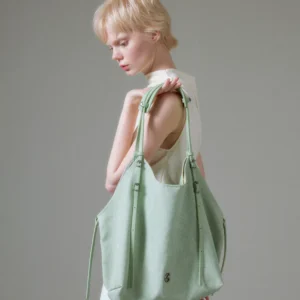
The Pale Mist Green tote has an open top and a 21 cm external base depth. JACD pictures an A4 notebook among the contents. Its integrated pouch gives loose items somewhere to go before you slide papers into the main space.
truuzēn for papers and a laptop
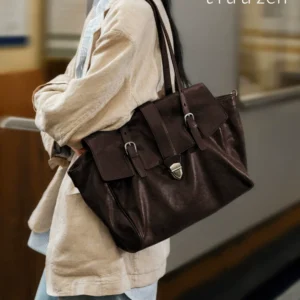
A central divider and smaller pockets give the Coffee briefcase five storage sections. Put your planner on one side so you can reach it without taking out your computer. The maker shows the bag open with a 14-inch laptop and a notebook.
The Pleasure Molecule for moving between rooms
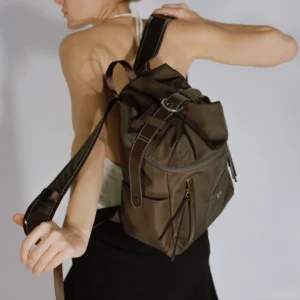
The Belt Backpack opens around the top with a zip. Its maker illustrates a 13-inch MacBook and an iPad Pro among the items it carries. Adjustable shoulder straps leave your hands free to carry a teaching tray or unlock a classroom.
What you carry before adding any books
The three empty weights differ by more than half a kilogram. Compare that starting weight with how much marking you usually bring home.
Textured PU tote, about 540 g
The JACD has a canvas-like texture and a polyester lining. Of the three pictured options it has the lowest empty weight and the deepest base. The open top makes it easy to spot the right exercise book.
Kid goatskin briefcase, about 1,150 g
The water-dyed, vegetable-tanned goatskin has a cotton lining. The flap fastens with a metal clasp. A zipped rear pocket is a useful place for a small item you want to reach between lessons.
Nylon backpack with cowhide details, about 775 g
The Ebony pack combines nylon and fine-ribbed cowhide. A magnetic buckle secures the front belt detail. The main opening has its own zip, so you can close it before walking across campus.
Check folder fit, access and carrying height
These three checks help with paperwork and devices that need to travel together.
- Measure the outside of your folder. A4 paper is 21 × 29.7 cm, but a ring binder or a folder with tabs can be wider. JACD illustrates an A4 notebook. For a rigid folder, check the width at the opening as well as the outside measurements.
- Measure your laptop with its sleeve on. The JACD diagram shows a 34 × 23.8 cm device. The briefcase and backpack use 14-inch and 13-inch examples respectively. Cases and screen proportions vary.
- Try your usual stack of books with the straps you prefer. The JACD strap adjusts from 50 to 102 cm in full length. The briefcase has a 15–28 cm handle drop. The backpack uses two adjustable straps for a load that travels on your back.
Teacher bag sizes and access at a glance
| Bag | Width × height × depth | Access | Maker capacity example |
|---|---|---|---|
| JACD JA2409624, Pale Mist Green | 34 × 36 × 21 cm | Open top, integrated pouch | A4 notebook and 34 × 23.8 cm laptop shown |
| truuzēn Shoulder Briefcase, Coffee | 35 × 24 × 17 cm | Clasped flap, divided interior, rear zip pocket | 14-inch laptop pictured inside |
| Belt Backpack, Ebony | 26 × 35 × 15 cm | Zip around the top | 13-inch MacBook in the capacity guide |
Product information and sources
MEMOO Editorial checked the pictured options against the makers’ colour photographs, dimension charts and capacity examples. The figures describe the outside of each bag. A rigid binder or protective sleeve adds to the size of the item inside.
About this page
By MEMOO Editorial. Published . Updated .